Training at Home Around Shift Work: Building a Schedule That Survives
A fixed Monday-Wednesday-Friday split lasts about a fortnight on a rotating shift pattern. Home training around shift work calls for a structure built around your rota, not an idealised week that rarely arrives.
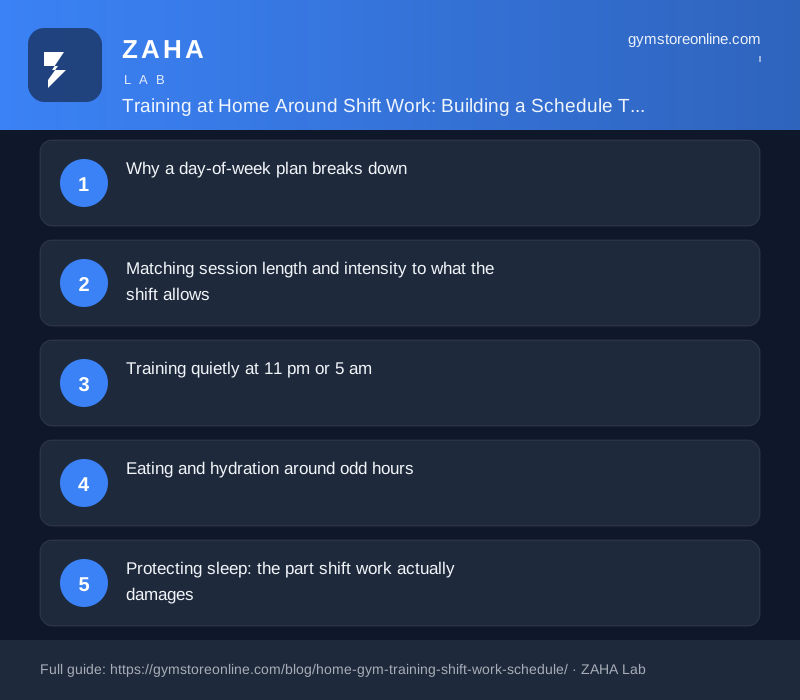
Why a day-of-week plan breaks down
A continental or 4-on-4-off rotation does not repeat every seven days, so any programme tied to Monday or Thursday collapses the moment nights begin. Anchor sessions to your shift cycle instead. If the pattern repeats every eight days, build an eight-day training block: session one on your first full day off, session two on the next available window, rest where the shift demands it. The calendar day becomes irrelevant.
Knowing your minimum matters too. Two sessions a week preserves most of the fitness built during a good block. One session slows the decline when the rotation is genuinely brutal. Zero sessions for more than ten days starts to cost measurable fitness. On a hard rotation, two 20-minute sessions with resistance bands and bodyweight keep your base intact until things ease.
Matching session length and intensity to what the shift allows
Having sessions at three different lengths makes the most of any window the rota provides: 15 minutes for the day after nights finish, 30 minutes for normal days, and 45 minutes for full rest days with decent sleep behind them. The 15-minute version is movement, not training. That distinction matters for how hard you push.
Intensity follows the same principle. Heavy compound lifts and sprint intervals belong on days with at least six hours of sleep behind you. Mobility work, moderate bodyweight circuits, and band work fit the low-energy windows. Matching effort to your actual recovery state produces more progress across a 12-week block than grinding through sessions on the wrong day.
Training quietly at 11 pm or 5 am
Night-shift workers arriving home at 7 am and early-shift workers leaving at 5 am share the same problem: the household and the neighbours are asleep. Hard floor impacts, rower slides, and dropped weights carry through a flat's ceiling quickly.
A thick mat under your feet absorbs heel strikes and cuts noise transmission significantly. Suspension trainers and resistance bands are almost silent: no weights to drop, no cable stack to clank. Bodyweight pressing and pulling done with control stays well below the level that disturbs anyone. Save jump movements for daylight hours, or replace them with step-based alternatives that produce the same cardiovascular output without the impact through the floor.
Eating and hydration around odd hours
A heavy meal an hour before a 12-hour night shift tends to cause discomfort during the second half. A meal of roughly 400 to 500 calories, weighted towards protein and slow-releasing carbohydrate, three hours before the shift starts gives the body enough fuel without the heaviness.
Hydration drops on long shifts, particularly in warm hospital or warehouse environments. Arriving home already dehydrated and then attempting to train produces poor output and slows recovery. A 500 ml glass of water before the session and another during it covers most of the gap. Avoid caffeine within six hours of your intended sleep window, and note that this window shifts daily on a rotation, so the cutoff time changes with it.
Protecting sleep: the part shift work actually damages
Training stresses the body. Sleep repairs it. Shift work compresses and fragments sleep in ways that adding more training volume cannot fix. A structured five-day programme on four hours of sleep will not outperform a simple three-day programme on seven. Protect the sleep window and adjust training volume around it, not the other way round.
Blackout curtains help considerably. A consistent wind-down routine at whatever clock time you go to bed, and keeping the bedroom below about 18 degrees Celsius, are both well-established aids for day sleep after nights. Finishing a session at least 90 minutes before you intend to sleep avoids the core temperature spike that can delay sleep onset. For more detail on structuring recovery, the guide on training frequency and rest days is worth reading alongside this one.
Gear worth considering
For quiet home sessions at odd hours, a few specific items make a practical difference. Browse the full range on the Fitness Accessories page, or start with these:
- Extra-thick 10 mm exercise mat: absorbs impact through the floor and cushions joints during early-morning or late-night sessions on hard surfaces.
- Resistance bands set: silent, compact, and versatile enough to cover most strength movements without any weights.
- All-in-one suspension trainer: door-frame mounted, ready in under two minutes, and completely silent in use.
- Universal rowing machine mat: cuts vibration transfer to the floor if you own a rower and need to use it at unsociable hours.
For session ideas that fit short windows, the workout routines for busy adults guide has sessions structured from 15 minutes upward.
Frequently asked questions
Can I still build strength training only twice a week on a rotating shift?
Yes, two sessions a week is enough to produce measurable strength progress, particularly for beginners and intermediate trainees. The key is keeping the effort appropriate in those sessions: compound movements, some form of progressive overload over time, and adequate protein. Three sessions per week produces more, but two is far from nothing.
Is it better to train before a night shift or after it ends?
Most people perform better before a night shift, when they are rested rather than depleted. A short session of 20 to 30 minutes in the early evening before a night shift is reasonable if you have slept well that day. Training immediately after a long night shift is possible at low intensity, but heavy or high-intensity work after no sleep carries an elevated injury risk.
What is the minimum I should do when the rotation gives no clear rest days?
Two 15-minute sessions of low-intensity movement, such as a resistance band circuit or a slow bodyweight flow, are enough to maintain joint mobility and general wellbeing without adding meaningful fatigue. Think of it as maintenance rather than training. Once the rotation eases and sleep improves, return to full sessions.