How Often Should You Train at Home? Rest Days and Weekly Frequency
Most home trainers see better results hitting each muscle group twice a week, not once. For home gym training frequency, two sessions per muscle group per seven days is the sweet spot most exercise science points to for healthy adults.
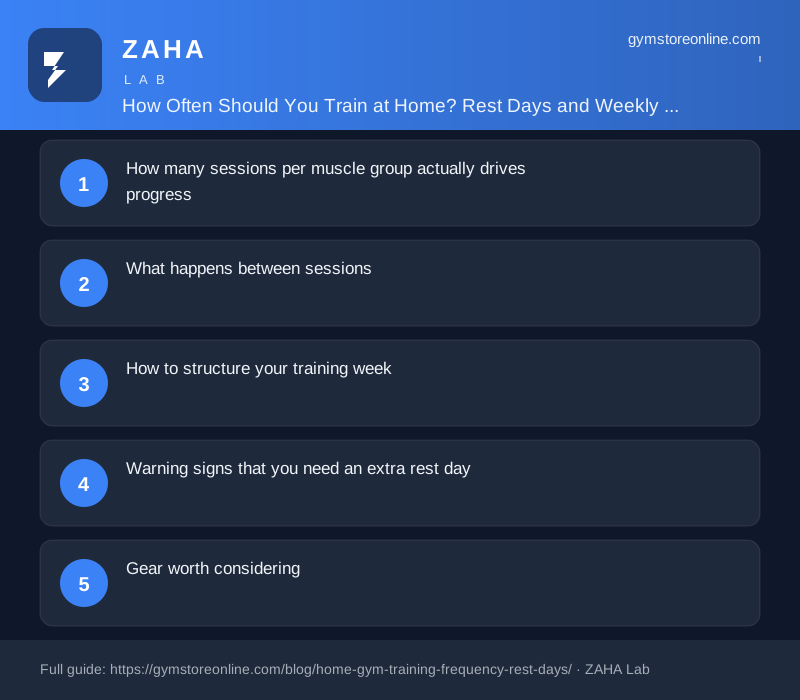
How many sessions per muscle group actually drives progress
Two sessions per week per muscle group is the frequency most exercise science points to for meaningful gains. One session per week can maintain fitness, but it rarely builds it efficiently. Volume matters too: three or more sessions only helps when each one is shorter and recovery is protected.
The practical implication: a well-designed home programme does not need to run six days a week. Three or four sessions, structured thoughtfully, will outperform five or six poorly planned ones. That is especially relevant if you train in a flat or spare room with a tight window before work.
What happens between sessions
Muscles do not grow during training. They grow during the 24 to 72 hours after it, when the body repairs micro-damage and lays down slightly more tissue than before. That process needs time and adequate protein. Training again before it finishes does not double the benefit. It competes with it.
Accumulated fatigue is the hidden cost. You might feel fine after two consecutive heavy lower-body sessions, but your force output on the third day is measurably lower even if soreness is absent. DOMS (delayed onset muscle soreness) is not a reliable guide to how recovered you actually are.
How to structure your training week
Three sessions per week suits a busy schedule well. A push/pull/legs split works with minimal kit:
- Session A (Push): dumbbell press, overhead press, lateral raises, tricep extensions.
- Session B (Pull): dumbbell rows, band pull-aparts, bicep curls, face pulls.
- Session C (Legs): goblet squats, Romanian deadlifts, lunges, hip thrusts.
Run A on Monday, B on Wednesday, C on Friday, or any three non-consecutive days. Each muscle group gets one direct session and one where it works as a secondary muscle, adding up to roughly 1.5 sessions per muscle group per week. For more on progressive loading, see the progressive overload at home guide.
Four days allows an upper/lower structure, which many home trainers find easier to programme:
- Day 1 (Upper A): dumbbell press, bent-over rows, overhead press, band rows.
- Day 2 (Lower A): squats, deadlifts, lunges, calf raises.
- Day 3 (Upper B): incline press, single-arm rows, lateral raises, curls, tricep work.
- Day 4 (Lower B): Romanian deadlifts, Bulgarian split squats, hip thrusts, hamstring curls.
Each muscle group appears twice per week across different exercises, managing fatigue while keeping frequency high. Rest on at least one of the four remaining days. The muscle recovery guide covers rest management in more detail.
Warning signs that you need an extra rest day
Planned rest days are built into any well-designed programme, but unplanned ones are sometimes necessary. Consider taking an extra day off if:
- Motivation to train has dropped noticeably for more than three consecutive days.
- Performance has declined across two or more sessions without an obvious cause such as poor sleep.
- You have persistent joint aching rather than standard muscular soreness.
- Resting heart rate is consistently 5 to 8 beats per minute above your normal baseline.
These are signs of accumulated fatigue, not weakness. One extra rest day rarely sets a programme back. Pushing through accumulating fatigue often does.
Gear worth considering
A 3 or 4-day home split needs very little equipment. Browse the full range at Home Gym Equipment. These four items cover most pressing, pulling, and hinge movements:
- A resistance bands set adds pulling and mobility work without taking up floor space.
- Selector-style adjustable dumbbells let you change load in seconds, replacing a full rack in the space of a shoebox.
- An all-in-one suspension trainer turns a door frame into a pull-based station for rows, face pulls, and more.
- An extra-thick 10 mm exercise mat protects joints during floor work and muffles impact in flats or upstairs rooms.
Consistency matters more than any single item. A 30-minute session that actually happens beats a planned 60-minute session that gets skipped. Schedule sessions like appointments and progress will follow.
Frequently asked questions
How many days a week should I train at home?
Three or four sessions per week is enough for most healthy adults building strength or improving body composition. The priority is hitting each muscle group at least twice per week across those sessions, not simply adding more training days.
Is it OK to train the same muscle group two days in a row?
Occasionally, yes, but it is not a good regular pattern. Muscles generally need around 48 hours to recover from a challenging session. If your schedule shifts by a day now and then, training on consecutive days is unlikely to cause harm.
Do rest days count as wasted training time?
No. Rest days are when adaptation happens. Training provides the stimulus; rest is where the body responds to it. Cutting rest days regularly tends to slow progress rather than speed it up.