
OZE SPORTS Adjustable Weight Bench - Utility Incline Decline Flat Foldable Bench Press Sit up fo
£39.99
View on Amazon →
Published 17 September 2026 · updated 2026-09-17 · by GymStoreOnline
Gym memberships across the UK go unused for months before most people quietly cancel. The adults who train at home consistently often outperform them — not because home training is easier, but because the friction of getting to a gym simply disappears.
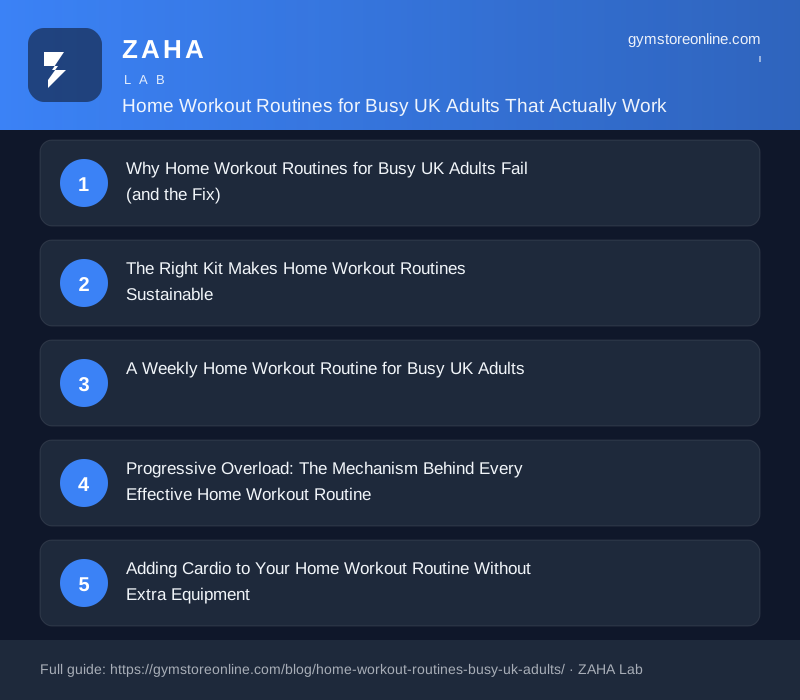
Home workout routines for busy UK adults work best when they are short, progressive and built around compound movements. Three to four sessions of 30–45 minutes per week, using an adjustable bench and a pair of dumbbells, is enough to build real strength and noticeable fitness within 8–12 weeks.
The failure point is almost never motivation. It is friction and structure. A round trip to the gym adds up to 90 minutes on top of a workout. Home training succeeds when setup time is under two minutes and the programme is structured enough to produce visible progress week on week.
Effective routines share three traits. First, they use compound movements that train multiple muscle groups at once — press-ups, squats, rows, hip hinges — so each minute of training delivers more return than isolation exercises alone. Second, they apply progressive overload: each week is slightly harder than the last, through more weight, more reps or shorter rest. Without this, the body adapts and stops changing. Third, they are short enough to feel doable even on a difficult day.
The routines that fail tend to overcomplicate the early stages, require too much kit upfront, or rely on motivation alone rather than a fixed schedule. Motivation is unreliable. A blocked diary slot three times a week is not.
You do not need a full commercial gym. What you need is the ability to load your body progressively across multiple movement patterns. A foldable adjustable weight bench unlocks dozens of exercises — chest press, incline row, dips, step-ups, Bulgarian split squats, tricep extensions — that bodyweight alone cannot replicate at useful intensities once you progress beyond the beginner stage.
For a practical entry point, the OZE SPORTS Adjustable Weight Bench (£39.99, 4.5 stars) adjusts across incline, decline and flat positions and folds flat for storage. That last point matters in a flat, box room or spare room where floor space is shared. It is a sound starting point for anyone testing whether home training suits them before committing further.
If you are certain this will become a regular routine, the YOLEO Adjustable Weight Bench (£69.99, 4.6 stars) carries ASTM certification at 300–375 kg, ships 98% pre-assembled, and offers 84–90 position combinations across incline, decline and flat. That range of angles means you can shift press emphasis from the lower to the upper chest, or adjust the incline for shoulder-dominant work, simply by repositioning the bench — effectively multiplying your exercise variety without adding equipment or floor space.
For a more complete setup that incorporates barbell training from day one, the YOLEO 400–900 KG ASTM-Certified All-in-One Weight Bench Set (£99.99, 4.6 stars) combines a bench press rack with a leg extension and curl fixture under a single footprint. The load ratings across its components mean the equipment will not be the structural limiting factor at any realistic training weight.
If your priority is a squat rack alongside a bench, the Yaheetech Adjustable Squat Rack (£49.98, 4.4 stars) adds a functional dip station and bench press support in a single unit. The TOTEBOX Adjustable Squat Rack Barbell Stand (£56.99, 4.6 stars) includes spotter arms, a push-up bracket and a dipping bar, giving more movement options for a modest additional cost. Both state explicit load capacities — which, as we explain below, is the baseline check before buying any rack.
If you are new to home training, spend your first four weeks mastering bodyweight and dumbbell movements on a bench before considering a squat rack. This builds the habit first and tells you which movements you will actually sustain before you invest further.
The most common mistake is trying to replicate a six-day gym split at home. A three-day full-body routine or four-day upper/lower split is more sustainable and, for most non-competitive adults, produces equivalent results in the same timeframe.
| Day | Focus | Key Movements | Duration |
|---|---|---|---|
| Monday | Upper push | Bench press, incline press, dips, shoulder press | 35 min |
| Wednesday | Lower body | Squats, Romanian deadlift, split squats, calf raise | 40 min |
| Friday | Upper pull + core | Dumbbell row, face pull, plank, bicep curl | 35 min |
| Saturday (optional) | Conditioning | Step-up intervals, burpee complex, dumbbell circuit | 25 min |
Rest days are productive. Muscle repairs and grows during recovery, not during the session itself. If life intervenes and you miss a session, continue from where you left off rather than doubling up. Doubling up leads to excessive soreness, increased injury risk, and eventually to stopping altogether.
Progressive overload is the single principle that separates a programme that produces change from one that does not. It means asking your body to do slightly more than it did last session — one extra repetition, 2.5 kg of additional load, or the same weight completed with 15 seconds less rest.
An adjustable bench makes this systematic. Steepen the incline to shift press emphasis from the lower to the upper chest. Decline the angle to intensify dips and increase the range of motion. Track the bench angle alongside your weight and reps in a simple notes app. Over 12 weeks, these small adjustments compound into meaningful strength gains that would be visible to anyone who knows you.
A bench rated to 300 kg or above — such as the ASTM-certified YOLEO models — will never be the structural limiting factor. Your own strength progression drives the programme forward. That is how it should work.
Effective home workout routines for busy UK adults do not require a treadmill or rowing machine. Cardiovascular conditioning can be built using the same bench you press from, slotted into the end of existing sessions:
Two 10-minute conditioning blocks per week, appended to existing strength sessions, improves cardiovascular fitness alongside muscle development without requiring additional gym days or equipment.
We apply consistent criteria before naming any piece of home gym kit on this site:
We do not recommend kit rated below 4.4 stars, nor items where structural claims cannot be verified from the product specification.
A barbell stand that flexes or creaks under load is not merely inconvenient — it is a safety risk. Before purchasing any squat rack, confirm it states a specific rated load capacity in kilograms, not just the phrase "heavy duty." Verify that buyer reviews mention stability under a loaded barbell, not only light dumbbell use. The Yaheetech Adjustable Squat Rack and TOTEBOX Squat Rack Barbell Stand both state explicit capacities; use that as your baseline check for any alternative you consider.
A home workout routine for busy UK adults is a strong fit if you:
You may want to reconsider if:
For those with limited space, a foldable bench covers a wide range of movements. The OZE SPORTS folds to a compact depth; the YOLEO all-in-one set trades a slightly larger footprint for significantly more movement variety with built-in barbell support.
Open your calendar and block three 35-minute slots — not when things calm down, but this week. Your first session needs nothing more than a bench and the routine in the table above. You do not need to feel ready.
Home workout routines for busy UK adults work because three sources of friction vanish at once: the commute, the queue for equipment, and the gym that closes before you finish work. What remains is the training — and that is the part that produces results.


Three to four days per week is the most sustainable frequency. Full-body sessions three times a week hit each muscle group twice in seven days, which is sufficient for meaningful strength and muscle gains. Adding an optional fourth session for conditioning keeps cardio improving without raising injury risk. Missing one session occasionally is fine — consistency over months matters far more than perfect attendance each week.
A bench alone covers a large proportion of both upper and lower body movements using dumbbells and bodyweight exercises. A squat rack becomes useful when you want to progress to heavier barbell squats, bench press with safety catches, or overhead press. For most beginners, start with a bench — the OZE SPORTS at £39.99 or the YOLEO at £69.99 are solid choices — and add a rack once you have outgrown dumbbell loads.
A foldable adjustable weight bench uses roughly 1.2 m by 0.5 m of floor space when in use and folds to approximately half that depth when stored against a wall. Adding a squat rack increases the footprint, but most models fit within a 2 m by 1.5 m area. A standard UK spare bedroom comfortably accommodates a bench-and-rack setup with enough space to move safely between exercises.
Most adults notice strength improvements within three to four weeks of consistent training, with visible muscle tone changes appearing within eight to twelve weeks, provided each session applies progressive overload and nutrition supports recovery. The biggest variable is consistency: three sessions per week, every week, over three months produces far better results than occasional intensive bursts. Keeping a simple log of weights and reps helps you see progress during the weeks when changes are not yet visible.
As an Amazon Associate we earn from qualifying purchases. Prices and availability are accurate as of the date shown and are subject to change — the price on Amazon at checkout is the one that applies.

Both cost under £30 and score 4.8/5. We compare the Sportneer and Amonax adjustable dumbbell sets for women to find which is worth
Find the best adjustable bench for ab and core workouts at home. UK guide covering angles, load ratings and picks under £100 for e
Everything you need to choose the best adjustable dumbbells for home workouts: weight range, locking mechanisms, build quality and