Tracking Progress at Home Without a Coach: Logs, Apps and Simple Measures
After four weeks of training alone, most people cannot accurately recall what weight they lifted on any given day. Tracking home gym workout progress with a log or app is the single most reliable way to confirm your training is actually working, without paying for a coach.
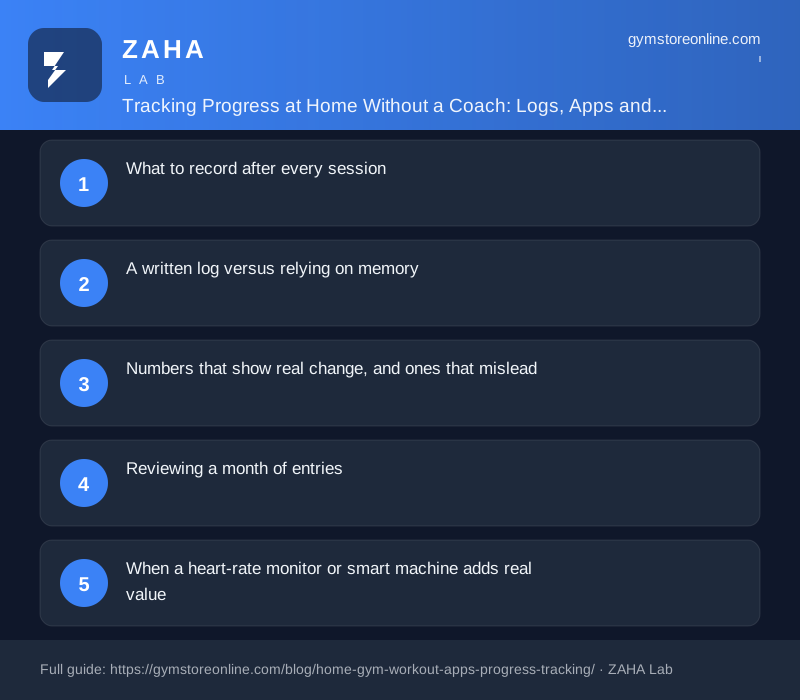
What to record after every session
Four things cover most of what matters: the exercise name, the load in kilograms or resistance level, the sets and reps completed, and an effort rating. That last one is often skipped. A simple 1-to-10 scale, where 10 means you could not have managed another rep, tells you whether a session was genuinely demanding or just felt that way. Write it down within ten minutes of finishing, while the detail is still fresh.
Skipping the exact numbers because “it’s roughly the same as last time” is how progress quietly stalls. Written records, kept consistently, are what make a log useful by month two.
A written log versus relying on memory
Memory compresses. By week five, most people remember their best sessions and quietly forget the average ones, which distorts any informal sense of whether things are improving. A spreadsheet or notebook does not compress. Look back at entries from 28 days ago and the comparison is immediate: 3 sets of 8 at 20 kg then, 3 sets of 10 at 22.5 kg now. That is a real signal.
Free apps such as Strong, Hevy, or a basic Google Sheets template work well for home training. Strong in particular saves your previous session automatically, so you see last week’s numbers before you lift. A plain notebook works equally well if you actually use it. The format matters far less than the habit of opening it every session.
The guides on progressive overload at home and training frequency and rest days explain how to build a programme worth tracking in the first place.
Numbers that show real change, and ones that mislead
Rep personal bests at a fixed load are among the most reliable home measures. Completing 11 reps of a goblet squat at 16 kg in week eight, where you managed 6 in week one, is a clear improvement. Tape measurements taken at the same time of day and the same day of the week give a slow but honest picture over months. Resting heart rate tends to fall over months of consistent aerobic work, though individual results vary.
Body weight alone misleads more often than it helps, particularly in the first six to eight weeks when muscle and fat can shift simultaneously. Scale weight tells you very little without context from the log. Sessions completed per week is a consistency metric many people overlook entirely: twelve sessions from a planned sixteen over a month is genuinely useful data.
Reviewing a month of entries
At the end of each four-week block, check three things. Look at whether rep counts at the same load are rising: if they are, a small load increase is usually the right call, around 2.5 kg on a barbell or one resistance band level. Check completion rate too: missing more than a quarter of planned sessions means the schedule needs fixing before the programme does. And look at effort ratings: a session that rates 6 out of 10 effort in week four, for work that rated 8 in week one, points to real adaptation.
Apply one change at a time: a load increase is usually simplest. Browse the Home Gym Equipment range for kit that makes small increments practical in a flat or spare room.
When a heart-rate monitor or smart machine adds real value
A chest strap or wrist-based heart-rate monitor gives objective effort data that a subjective 1-to-10 score cannot. It is particularly useful for cardio work in a spare room where perceived effort drifts without external feedback. Smart resistance machines with built-in load tracking remove one logging step entirely: the machine records the resistance for you, leaving you to note only reps and effort.
Gear worth considering
- The AEKE S1 Pro smart home gym with AI trainer tracks resistance and reps automatically, which removes the need to log load manually mid-session.
- A PROIRON digital skipping rope with counter gives you a precise jump count every session, making cardio progress measurable rather than approximate.
- The TOUSAINS CR63 2-in-1 home gym cable machine and rower combines two training modes in one unit, which suits garages or larger spare rooms where varied training is the goal.
- A resistance bands set adds progressive load options to bodyweight sessions without taking up floor space; colour-coded resistance levels make load tracking straightforward from session to session.
Frequently asked questions
How often should you review your training log?
A quick check at the end of each session takes under two minutes and keeps entries accurate. A longer review every four weeks gives enough data for a sensible decision about whether to progress load, add reps, or adjust how many sessions you do each week.
Is a phone app better than a paper notebook for home training?
Both work, provided you use them consistently. Apps such as Strong or Hevy automatically show your previous session's numbers before you start, which removes a small but useful friction. A notebook has no battery and no login screen, which some people find easier to maintain long-term.
What if progress slows after a few months?
A plateau after several months of consistent training is normal. Check your log for changes in sleep, session frequency, and whether effort ratings have quietly dropped for the same work. Adjusting rest periods or introducing a different movement pattern are practical first steps before increasing overall volume.