Training With a Partner Who Is Much Stronger: One Home Gym, Two Loads
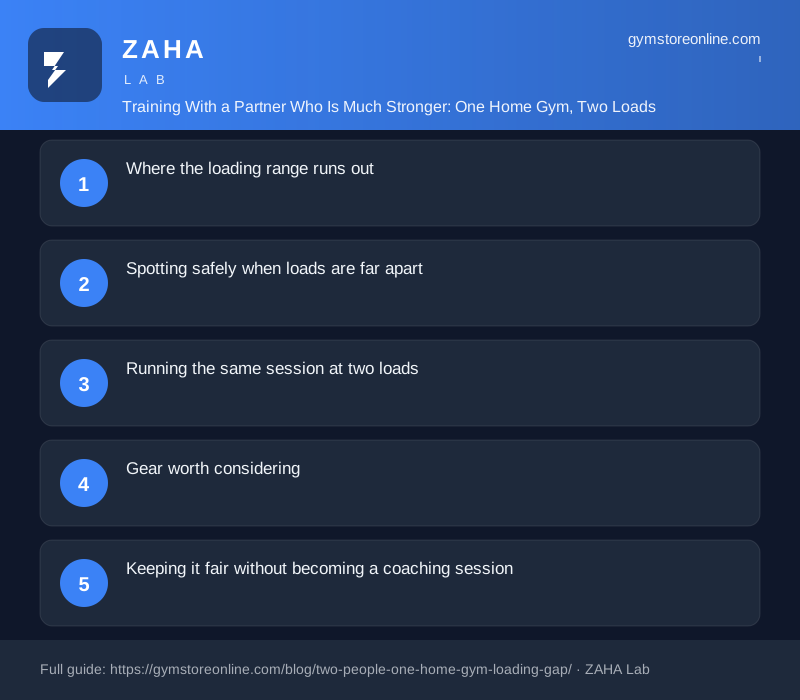
One barbell, two people, and a 40 kg difference in working weight. Training with a partner who is much stronger is manageable, but only if the kit covers both loading ranges and the session structure keeps both of you actually working.
Where the loading range runs out
Most selector-style adjustable dumbbells top out at 24 kg or 32 kg per hand. For most upper-body work, that covers an intermediate lifter. A stronger partner doing heavy Romanian deadlifts or weighted carries will hit that ceiling within a few weeks. A standard Olympic barbell loaded to 100 kg covers most of the gap, but only if the rack handles the weight safely at both ends of the range.
If the weaker partner's bench working weight is 40 kg and the stronger partner's is 80 kg, the bar is never at a neutral loading point. Someone is always stripping or adding plates. In a small garage or spare room, that can add two to three minutes per exercise.
Spotting safely when loads are far apart
When the weaker partner is under the bar, hand-spotting works well for lighter loads. For anything approaching that partner's true limit, safeties set at the correct height are more reliable than reaction time. Set them 2 to 3 cm below the lowest point of the lift: just below chest height for bench, just below parallel for squat. A power rack with adjustable safeties handles both partners without full reconfiguration between sets. A squat stand without safeties does not.
The stronger partner needs safeties too, particularly for near-maximal work. A rack that covers both loading ranges and both risk profiles is the more practical long-term choice for a shared home gym.
Running the same session at two loads
Alternating sets within the same exercise is faster than running separate training blocks. Person A sets up, lifts, and strips or adds weight. Person B does the same. For barbell work, aluminium lever collars make this realistic in under 30 seconds per change. Selector-style adjustable dumbbells switch load in roughly 15 seconds, which fits within a normal rest period without breaking the session's rhythm.
Where the loads differ by more than two plate changes, offset the movements instead. The stronger partner runs a heavier compound set while the weaker partner does an accessory or mobility drill. Both people keep moving, and the equipment is never idle. For more on structuring progressive sessions at home, see the guide to progressive overload at home.
One common trap: the stronger partner consistently trains at 60% of their own capacity to stay in sync, and stalls within a few weeks. Each person should work to their own RPE (rate of perceived exertion). An RPE 8 set for the weaker partner and an RPE 8 set for the stronger one both produce adaptation. The loads on the bar differ; the effort should not.
Gear worth considering
In a shared home gym, load change speed determines how much of the session is actual training versus setup. These three items make a real difference.
- Selector-style adjustable dumbbells: These selector-style adjustable dumbbells let both partners switch loads in one motion, keeping transitions under 15 seconds and rest periods intact.
- Resistance bands set: A resistance bands set gives the weaker partner a way to add accommodating resistance to barbell movements, or to work through accessory exercises on the mat while the bar is occupied.
- Extra-thick 10 mm exercise mat: An extra-thick 10 mm exercise mat matters more in shared sessions, where floor work between sets is common. Particularly useful in a tiled garage or hard-floored spare room.
For a full overview of what a shared space needs, browse Home Gym Equipment. If more than two people train in the same flat or house, the guide to training in a shared house covers scheduling and noise in more detail.
Keeping it fair without becoming a coaching session
Agree on session roles before the first set. Decide who controls rest timing, whether form cues are welcome, and what to do when one person finishes the workout earlier. Most shared training arrangements break down over unsolicited coaching from someone the other person also eats dinner with, not over loading logistics.
Separate programming works better than a shared plan. Each person follows their own session goals; the shared elements are the space, the equipment, and possibly the warm-up. This holds even when the goals diverge: one partner building strength, the other focused on conditioning.
Frequently asked questions
Can two people share one set of adjustable dumbbells when the strength gap is large?
Yes, provided the dumbbell range covers both loading needs. If one partner needs 8 kg and the other needs 28 kg, a set running to 32 kg per hand covers both. Where the stronger partner needs more than 32 kg per hand for most compound movements, a barbell is the more practical addition to the shared kit.
Is it safe for the weaker partner to lift alone without the stronger partner present?
With safeties correctly set, solo lifting is safe for most exercises at submaximal loads. The key step is setting safeties before every session, not adjusting them on the fly mid-workout. Any lift taken genuinely to failure without safeties carries risk regardless of whether a partner is nearby.
How do we avoid one person always standing around waiting?
Offset the movements rather than taking strict turns on the same exercise. While one person runs a barbell set, the other works through an accessory or mobility drill on the mat. This keeps both partners occupied and reduces total session length.