Treadmill or Outdoor Running? What UK Weather and Your Joints Decide
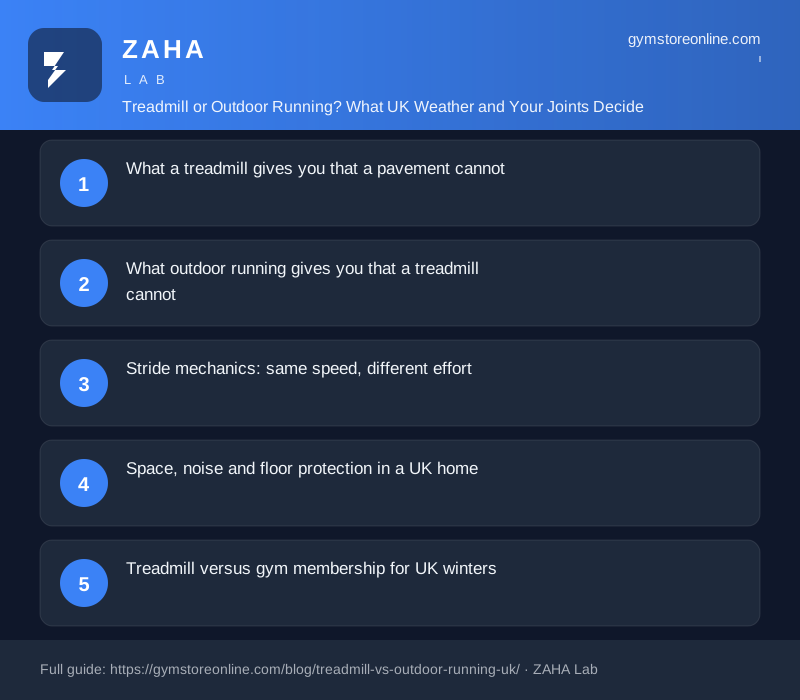
UK runners spend roughly four months of the year running in darkness, rain, or both. For most people training at home, the treadmill-vs-outdoor-running decision is not really about preference. It is about what gets done.
What a treadmill gives you that a pavement cannot
A treadmill belt controls pace precisely. If you want to run at 9 km/h for 40 minutes, the machine holds that number regardless of a headwind or a wet pavement in November. Incline can be dialled in without needing a hill. For zone 2 cardio at home, that consistency matters: it is easier to keep heart rate steady when pace is not drifting between lamp posts.
The cushioning difference is real. Most treadmill decks absorb noticeably more impact than tarmac or concrete, which many runners with knee discomfort find useful for shorter recovery runs. That said, softer impact is not the same as 'no impact', and treadmill running does not replace physiotherapy advice.
Evening safety is a practical issue in the UK between October and March. Running outside in the dark on unlit suburban roads carries risks a treadmill removes entirely.
What outdoor running gives you that a treadmill cannot
Uneven ground forces small stabilising muscles in the ankle, hip, and foot to work constantly. A treadmill belt is flat and predictable. Over time, exclusive treadmill running can leave those stabilisers underdeveloped, which may become noticeable when you return to the road.
Wind resistance accounts for roughly 2 to 5 per cent of the energy cost of outdoor running at typical training paces. Setting a treadmill to 1% incline is a widely cited way to approximate that extra effort, though it is an approximation rather than an exact match.
You also lose the visual and mental variety of an actual route. For longer runs, that matters more than most people admit until they are forty minutes into a treadmill session staring at a garage wall.
Stride mechanics: same speed, different effort
At the same reported pace, outdoor running and treadmill running feel different because they are different. The belt assists leg turnover slightly, reducing the demand on your hamstrings compared with propelling yourself forward on a road. Research suggests that at paces below about 13 km/h the mechanical differences are modest; at faster paces, the gap widens. Setting the treadmill to 1% incline closes most of that gap at moderate speeds, though it remains an estimate rather than a precise correction.
Space, noise and floor protection in a UK home
A folded treadmill typically takes up around 90 x 50 cm. Unfolded and in use, most models need a space of at least 180 x 80 cm, plus clearance behind the user: allow at least 60 cm at the rear as a safety buffer. A standard UK spare room can usually accommodate that, though a narrow garage bay may need careful measuring before purchase.
Vibration and motor noise travel through floors. If you are in a flat above neighbours, run before 9 pm and use a dense rubber mat under the machine. Upstairs flats should also check with their building insurer before installing anything heavier than about 100 kg.
Treadmill versus gym membership for UK winters
A mid-range home treadmill costs between £400 and £800. A gym membership in a UK city averages around £40 to £55 per month. If winter weather stops outdoor running for four months, that is roughly £180 in gym fees before you have covered a single spring or summer session. The maths shifts toward a home machine fairly quickly for people who run three or more times a week. Browse Cardio Equipment and check the site's guide to best treadmills for home use for current options at different price points.
Gear worth considering
- A 2-pack non-slip treadmill mat placed under the machine reduces vibration transfer and protects hardwood or laminate floors from the frame feet.
- A treadmill and equipment floor mat in a larger format is useful if you also keep other cardio kit in the same room and want a single continuous protective surface.
- A weighted jump rope is a compact, low-noise addition for warm-up sets or on days when the treadmill is occupied by someone else in the household.
A sensible mixed week
Three sessions a week works well as a starting point: one outdoor run for the uneven-surface loading and mental variety, one treadmill session at a controlled easy pace for consistent aerobic work, and one session that uses whichever suits the conditions on the day. That structure keeps stabiliser work coming from outdoor miles while still letting the treadmill cover the dark, wet evenings when going outside simply does not happen.
Frequently asked questions
Is treadmill running easier than running outside?
At the same speed, treadmill running is slightly easier because the belt assists leg turnover and there is no wind resistance. Setting the incline to 1% brings the effort closer to outdoor running at moderate paces, though it is not a precise match at all speeds.
How much space does a treadmill actually need in a UK home?
Most folding treadmills store in roughly 90 x 50 cm of floor space. In use, plan for at least 180 x 80 cm plus a 60 cm safety buffer behind the rear of the deck. Measure your room before buying and check whether the door swings into the running area.
Will running on a treadmill upstairs disturb my downstairs neighbours?
Treadmill motors and footfall both create vibration that travels through timber floors. A dense rubber mat under the machine reduces but does not eliminate transmission. Running before 9 pm, keeping speed moderate, and informing neighbours you have the equipment are all practical steps worth taking before installation.