
OZE SPORTS Adjustable Weight Bench - Utility Incline Decline Flat Foldable Bench Press Sit up fo
£39.99
View on Amazon →
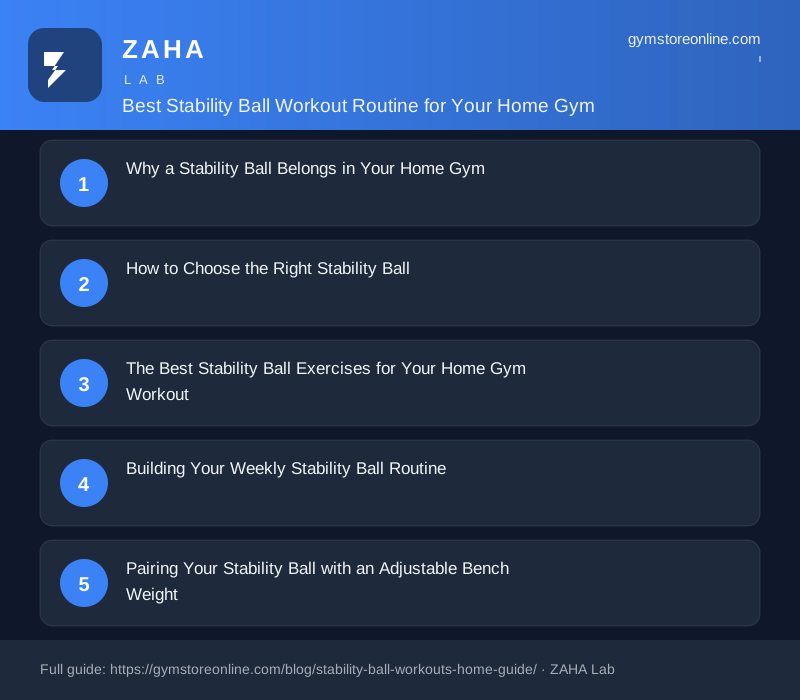
Published 17 September 2026 · updated 2026-09-17 · by GymStoreOnline
Most gym balls gather dust after a week — the ones that don't are doing more work per session than a rack of dumbbells. A stability ball workout routine for your home gym covers core, glutes, back, chest, and shoulders using a single piece of kit that costs under £30. The unstable surface forces stabiliser muscles into every rep, raising the training demand well beyond what the same movement on flat ground produces.
A stability ball — also called a Swiss ball or exercise ball — turns ordinary bodyweight movements into compound challenges. A standard press-up keeps your torso stable by default; prop your feet on the ball and your abs, obliques, and spinal erectors must fire continuously to stop you pitching sideways. That additional muscular demand is why physiotherapists have used the ball in rehabilitation for decades and why coaches include it in functional strength programmes.
The mechanism is reactive neuromuscular training: because the surface deforms slightly under load, your body cannot lock into a fixed position. Every rep demands small corrective contractions from muscles you would miss entirely on stable ground. For home use, the ball is also genuinely practical — it compresses for storage, doubles as an active sitting chair, and costs a fraction of any other resistance equipment.
Two factors matter above everything else: burst resistance and diameter.
Burst resistance means the ball deflates gradually if punctured rather than rupturing under load. Any ball used for exercises involving bodyweight or dumbbells must be explicitly rated burst-resistant (also labelled anti-burst). Unrated balls can fail suddenly, dropping you to the floor mid-rep — a serious injury risk.
Diameter is matched to your height. Sitting on a correctly inflated ball, your hips and knees should both sit at roughly 90 degrees. If your knees are higher than your hips, size up.
| Your Height | Recommended Diameter |
|---|---|
| Under 5'0" (152 cm) | 45 cm |
| 5'0"–5'7" (152–170 cm) | 55 cm |
| 5'7"–6'2" (170–188 cm) | 65 cm |
| Over 6'2" (188 cm+) | 75 cm |
Weight capacity matters too. Look for a rating that comfortably exceeds your body weight if you plan to add dumbbell load. Most quality balls are rated between 100 kg and 300 kg.
Inflate until the ball reaches its stated diameter with slight give when you press your hand firmly against the surface. Under-inflated balls wobble unpredictably; over-inflated balls are too firm to deform usefully. Most reputable models include a hand pump and a diameter guide in the box.
If a listing does not state "burst-resistant" or "anti-burst" clearly in the title or specifications, skip it regardless of price. Vague terms like "thickened" or "heavy-duty" are not safety ratings. A ball that fails under load is a serious hazard, and the price difference between rated and unrated models is usually under £10 — it is not worth the risk.
The following moves form a balanced full-body programme. You need only the ball and roughly 2 metres of clear floor space.
Ball crunch — lie with your lower back supported on the ball, feet flat on the floor. Curl your torso upward. The ball's curvature increases your range of motion compared with a floor crunch, and the balance requirement keeps the obliques working throughout.
Prone roll-out — start in a press-up position with your shins resting on the ball. Raise your hips by rolling the ball towards your hands, then return slowly. This is one of the most demanding bodyweight core exercises available without cable equipment.
Plank with elbows on ball — elbows on the ball, feet on the floor. The ball introduces instability in all planes at once. Start with 20-second holds and build progressively to 45 seconds.
Wall squat with ball — place the ball between your lower back and a flat wall. Squat until your thighs are parallel to the floor. The ball guides your spine into a neutral position and reduces shear force at the knee — useful for learning squat mechanics or training around minor knee discomfort.
Hamstring curl — lie on your back, heels resting on the ball. Raise your hips off the floor and curl the ball towards you by bending both knees. One of the most effective posterior-chain exercises available without a machine or weights.
Single-leg glute bridge — upper back on the ball, one foot flat on the floor, hips lifted. Extend the raised leg straight out. Progress from both feet to a single leg once the bilateral version is comfortable across three consecutive sessions.
Press-up with feet elevated — feet on the ball, hands on the floor. Your core must brace continuously to prevent your lower back from sagging, adding significant work compared with a standard floor press-up.
Dumbbell chest press on ball — upper back and shoulders on the ball, hips bridged, dumbbells in hand. Effective for light to moderate loads; for heavier sets, the position becomes awkward — which is exactly where a weight bench earns its place alongside your ball.
Three sessions per week with a rest day between each is a practical structure for most people:
| Day | Focus | Key Moves |
|---|---|---|
| Monday | Core + upper body | Ball crunch, prone roll-out, elevated press-up |
| Wednesday | Lower body | Wall squat, hamstring curl, single-leg bridge |
| Friday | Full body | Plank on ball, dumbbell press, wall squat |
Begin each session with 2–3 minutes of gentle spinal rolling to warm the stabilisers. Work through 3 sets of each exercise at 10–12 reps. When 12 reps feel manageable across three consecutive sessions, add a fourth set or shorten rest periods before adding external load.
Once you are comfortable with bodyweight stability ball work and want to progress the load, an adjustable weight bench changes what is possible. The ball delivers instability training and high muscle activation at low to moderate loads; a bench provides a stable, angle-adjustable platform for heavier dumbbell and barbell work that the ball cannot safely support.
The OZE SPORTS Adjustable Weight Bench (£39.99, 4.5 stars) is a foldable incline, decline, and flat bench that stores alongside a stability ball without claiming much floor space — a sensible first addition to a ball-based home gym. If you want more angle variation as your programme develops, the YOLEO Adjustable Weight Bench (£69.99, 4.6 stars, ASTM-certified to 300–375 kg, 84–90 positions, 98% pre-assembled) offers a third-party verified load rating and a wide range of positions that replicate what you would find at a commercial gym.
When your training progresses to loaded barbell work, the YOLEO 400–900 KG All-in-One Weight Bench Set (£99.99, 4.6 stars) combines a press rack with leg extension and curl attachments — covering the major movement patterns that stability ball training cannot easily load with heavy weight. If you already own a bench and want only a rack, the Yaheetech Adjustable Squat Rack (£49.98, 4.4 stars) includes a functional dip station and provides barbell support at a lower entry price.
None of this equipment is necessary to start. The ball alone supports months of productive training. But when bodyweight is no longer challenging, a bench in the £40–£70 range is the logical next step without occupying significant floor space.
Good fit:
Consider alternatives if:
For the bench and rack recommendations in this article, our minimum threshold was a 4.4-star average rating and a clearly stated load capacity. Where an ASTM certification was listed, we treated that as a positive signal because it represents independent third-party verification rather than a manufacturer's own claim. We also selected models with transparent assembly and storage information, since both matter in a home gym context.
For the stability ball itself, apply the same standard: explicit burst-resistance certification, a load rating above your body weight, an included pump, and a diameter matched to your height using the sizing table in this guide.


Match the diameter to your height: 55 cm for heights between 5'0" and 5'7", 65 cm for 5'7" to 6'2", and 75 cm if you are over 6'2". Seated on a correctly inflated ball, your hips and knees should both be at roughly 90 degrees. If your knees rise above your hips, size up. Always choose a model explicitly rated burst-resistant before anything else.
For light dumbbell work and bodyweight movements, yes — the ball handles chest press, shoulder exercises, and core work effectively at moderate loads. For heavier sets, a dedicated adjustable bench is safer and more controllable. Models such as the OZE SPORTS Adjustable Weight Bench (£39.99) or the YOLEO Adjustable Weight Bench (£69.99) pair well with ball training as your programme progresses.
Two to three sessions per week is the right starting point, with at least one full rest day between sessions. Because the ball activates stabiliser muscles that rarely get direct work, it is common to feel soreness in the obliques and spinal erectors after early sessions. Start with two sessions weekly and add a third once those feel manageable, before increasing load or volume.
Yes, provided the ball is burst-resistant, correctly sized, and properly inflated. Keep the load modest relative to what you would use on a flat bench — the instability reduces the maximum weight you can safely control. For sets above roughly 15–20 kg per hand, an adjustable weight bench gives you a more stable base; the YOLEO (£69.99, ASTM-certified to 300–375 kg) is a reliable option.
As an Amazon Associate we earn from qualifying purchases. Prices and availability are accurate as of the date shown and are subject to change — the price on Amazon at checkout is the one that applies.

Both cost under £30 and score 4.8/5. We compare the Sportneer and Amonax adjustable dumbbell sets for women to find which is worth
Find the best adjustable bench for ab and core workouts at home. UK guide covering angles, load ratings and picks under £100 for e
Everything you need to choose the best adjustable dumbbells for home workouts: weight range, locking mechanisms, build quality and