Home Gym Injury Prevention: 7 Mistakes That Land UK Lifters on the Physio Couch
One in three home gym users sustains a training injury within their first year of solo lifting. Home gym injury prevention doesn't require a personal trainer - it requires catching specific form errors before they compound into something that sends you to the physio.
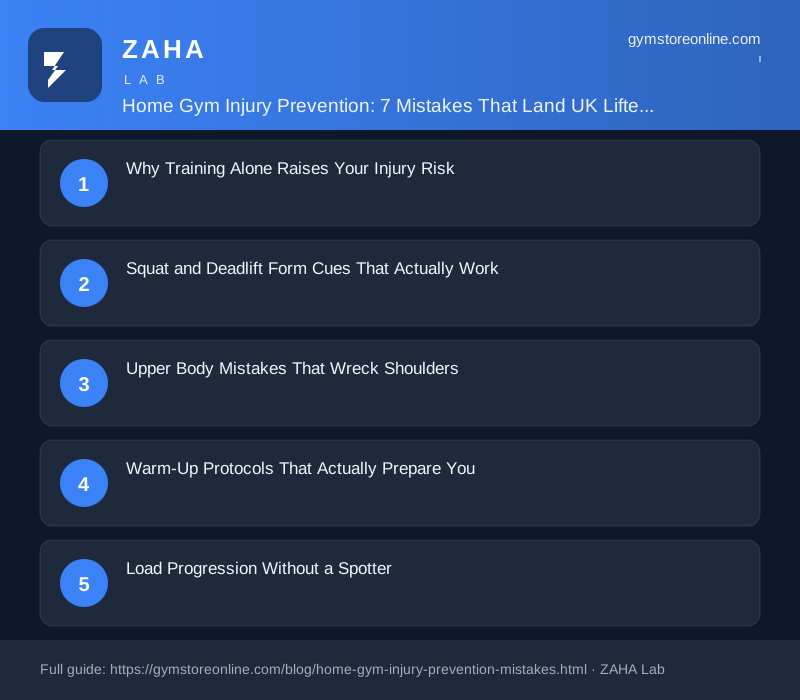
Why Training Alone Raises Your Injury Risk
Without a coach in the room, feedback loops vanish. Nobody flags the knee cave on your fourth squat set. Nobody notices that your wrist has started bending backward on bench press. A 2022 survey by the British Journal of Sports Medicine found that self-taught resistance trainers were 40% more likely to develop overuse injuries than those with supervised onboarding.
The main culprit isn't intensity. It's repeating flawed movement patterns. Do a deadlift with a rounded lumbar spine 200 times before anyone corrects you and you've trained a dysfunction into your nervous system.
Three factors compound the problem in home gyms: no mirrors or poorly positioned ones, no external loading feedback because you don't feel bar path drift until something pulls, and programming autopilot where you repeat the same session because nobody is there to change it.
Squat and Deadlift Form Cues That Actually Work
Record every squat session from the side, camera at hip height. You're looking for two things: knees tracking over the second toe, and depth reaching parallel. If your heels rise, ankle dorsiflexion is limited - spend 90 seconds doing ankle circles against a wall before loading the bar.
Cue: "Spread the floor." Push your feet apart as if trying to split the ground beneath you. This activates the glutes and prevents valgus collapse far better than the generic "knees out" instruction.
For the deadlift, the most common home gym error is starting with the bar too far from the shins. It should sit 1 inch from your tibia at the start of the pull, not 4 inches. Every extra inch of forward drift multiplies shear force on the lumbar spine. Cue: "Drag the bar up your legs." You'll scrape your shins occasionally. That's correct.
Before loading the deadlift, practise the hip hinge with a broomstick held behind your back, touching your head, upper back and tailbone simultaneously. If you can't maintain contact at all three points during the movement, the weight on the bar is irrelevant - the pattern isn't there yet.
Upper Body Mistakes That Wreck Shoulders
Shoulder injuries account for 36% of all gym injuries in recreational lifters (British Orthopaedic Association, 2023). Most trace back to two errors: internal rotation during pressing and neglecting the posterior shoulder chain.
On the overhead press, watch for the "chicken neck" - the head jutting forward as the bar passes the face. This compresses the cervical spine. Cue: "Push your head through the window." As the bar clears your nose, drive your chin forward and up so the ear finishes behind the bicep at lockout.
On bench press, retract the scapulae before every rep. Pull the shoulder blades together and down as if holding a pencil between them. This positions the glenoid correctly and reduces shear on the rotator cuff. Most home gym lifters skip this step because nobody reminds them.
Pull movements are underprogrammed by almost every self-coached lifter. For every pushing set, include at least one pulling set - rows, face pulls or band pull-aparts. A 2:1 pull-to-push ratio protects the shoulder girdle across months of training.
Warm-Up Protocols That Actually Prepare You
Five minutes on the treadmill does nothing specific for a session of heavy squats. A warm-up should prepare the exact joints, muscles and movement patterns you're about to load.
For a lower-body session: 10 glute bridges, 10 bodyweight squats with a 2-second pause at the bottom, 10 lateral band walks each direction, and 90 seconds of ankle mobility work against a wall. Total time: under 6 minutes.
For upper body: 15 band pull-aparts, 10 wall slides, 10 scapular push-ups, 5 slow controlled arm circles. Done in under 4 minutes.
Static stretching before lifting reduces force output by up to 8% (Journal of Strength and Conditioning Research, 2019). Save it for after the session. Pre-lift, your goal is to raise tissue temperature, activate the target muscles and rehearse the movement pattern without load.
Load Progression Without a Spotter
The standard recommendation is a 5-10% load increase per week for beginners and 2-5% for intermediates. Most home gym users ignore this and add 5 kg whenever a session feels easy. That's how tendons get strained.
Use a training log. Record weight, sets, reps and an RPE score (1 to 10, where 10 is maximum effort) for every working set. If your RPE on the final set exceeds 8, don't increase load next session. If it stays below 6 for three consecutive sessions, a 5% increase is appropriate.
Solo training means you can't push to absolute failure safely on free weights. Leave 2 reps in reserve on every set. If you're benching alone, use a power rack with safety bars set at chest height - or switch to dumbbells, where dropping the weight is controlled and safe.
Gear Worth Considering
A few items make a measurable difference to injury risk without requiring a large outlay.
- [FABRIC RESISTANCE BANDS SET] - Useful for glute activation, warm-up drills and face pulls. A set of light, medium and heavy loop bands covers the full range of exercises. Small, cheap and used on every lower-body session.
- [ADJUSTABLE SQUAT RACK WITH SAFETY SPOTTER ARMS] - If you're pressing or squatting without a training partner, a rack with correctly set safety pins is not optional. Look for a model with a weight capacity rated at least twice your working load.
- [FRACTIONAL WEIGHT PLATES 0.5 KG AND 1 KG] - The jump from a 20 kg to 22.5 kg dumbbell is large for an overhead press. Fractional plates allow 0.5 kg increments, which smooths the progressive overload curve and avoids one of the commonest causes of tendon overload: load jumps that are simply too large.
Frequently Asked Questions
How do I check my own form without a coach?
Film every session from the side and from behind. Use a tripod or prop your phone against a water bottle at hip height. Review the footage the same day and compare key positions - the bottom of a squat, the lockout of a deadlift - against reference videos from credentialed coaches. Seeing yourself move is the closest substitute for real-time feedback.
Is it safe to train through muscle soreness?
Delayed onset muscle soreness (DOMS) in the belly of a muscle is fine to train through at reduced intensity. Sharp pain in a joint, tendon or bone is different. Stop the movement, rest for 48 hours, and if the pain persists, see a physiotherapist before returning to that lift.
How quickly should a beginner add weight?
Most beginners can add load to their main lifts every session for the first 8 to 12 weeks - a method called linear progression. After that, weekly increases are realistic. If progress stalls earlier than expected, the problem is almost always sleep quality or calorie intake, not the training programme.
What is the highest-risk lift for a solo home gym user?
The barbell back squat without a power rack. If you fail a heavy squat with no safety bars and no training partner, your options are limited. Either squat inside a rack with safety pins set to chest height, use a safety squat bar, or switch to goblet squats and the leg press until you have proper equipment in place.