Home Gym Injury Prevention: 6 Mistakes UK Trainees Make (and How to Train Safely Without a Coach)
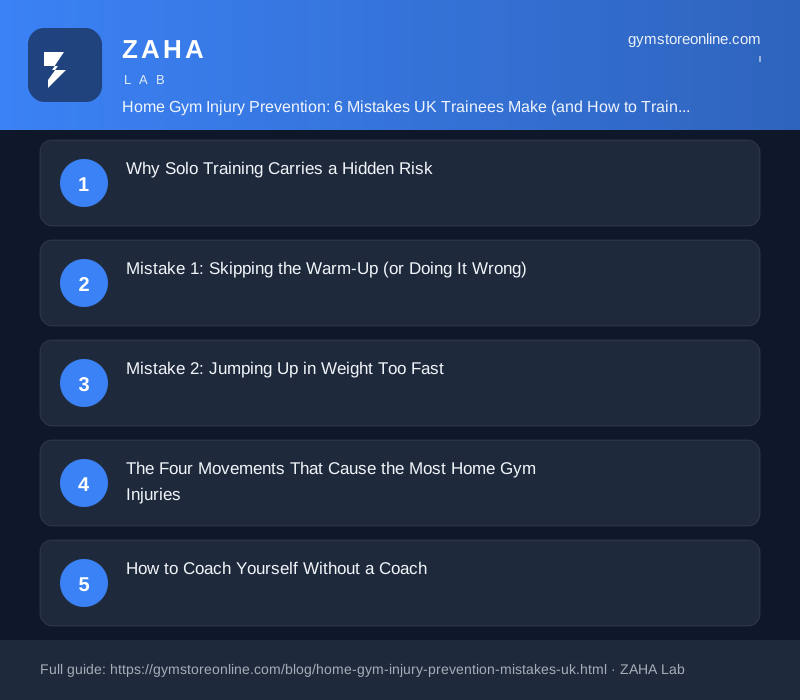
Around 40% of resistance training injuries are directly linked to training without supervision. Home gym injury prevention starts before you pick up a weight: most injuries trace back to either a skipped warm-up or loading that outpaces what the body can actually handle.
Why Solo Training Carries a Hidden Risk
When you train alone, there is no one to tell you your bar path drifted on rep 6. Or that your lower back rounded before you even noticed. Research in the Journal of Strength and Conditioning Research found that technique breakdown is the single biggest predictor of acute injury in recreational lifters. That is not an argument against home training. It is an argument for building the habits that usually come from a coach watching from the side.
The fix is not complicated. You need a system, not supervision.
Mistake 1: Skipping the Warm-Up (or Doing It Wrong)
Most people either skip the warm-up entirely or spend five minutes on a stationary bike and call it done. Neither prepares joints and muscles for loaded movement.
A useful warm-up has two parts. The first is general: 3-5 minutes of movement that raises your heart rate and increases blood flow. The second is specific: bodyweight or very light-load versions of the movements you are about to perform.
For squats, that means goblet squats with a 5 kg plate before you touch the barbell. Bench press sessions need two sets of push-ups, then one set at 50% of your working weight. Neither is optional. Cold tissue tears faster than warm tissue. A 2021 study in Sports Medicine found a structured warm-up reduces soft-tissue injury risk by 38%.
Mistake 2: Jumping Up in Weight Too Fast
Progressive overload is the engine of any strength programme. But most home gym trainees apply it wrong, adding 5 kg when they could only complete the previous weight with compromised form.
One reliable rule: increase load only when you can complete every rep of every set with clean technique at your current weight, across two consecutive sessions. Not one. Two.
Jumping from a 60 kg deadlift to 80 kg in a single week is how lumbar disc injuries happen. Muscles adapt faster than connective tissue. Tendons and ligaments need 6-8 weeks to catch up to strength gains.
The Four Movements That Cause the Most Home Gym Injuries
These are the exercises where form breaks down most often in solo training. One specific cue for each.
- Barbell Back Squat: Cue: "Chest up, knees track over little toes." The most common error is forward lean from limited ankle dorsiflexion. A 1.25 kg plate under your heels can reveal whether mobility is the limiting factor.
- Deadlift: Cue: "Push the floor away, don't pull the bar up." This shifts your mental model from hinging to pushing, which naturally braces the lumbar spine. Record yourself from the side. Rounded mid-back is acceptable; rounded lower back is not.
- Overhead Press: Cue: "Bar leaves chin, head goes through." The bar path should be a straight vertical line. Any forward drift puts shear load on the rotator cuff.
- Bench Press: Cue: "Bend the bar apart." External rotation of the wrists activates the posterior deltoid and protects the shoulder joint. Most pec tears occur when the grip is narrow and wrists stay vertical throughout the set.
How to Coach Yourself Without a Coach
A few habits together replace most of what a coach does from the side of the platform.
First, record yourself. Set your phone sideways on a small tripod or prop it against a weight stack. Watch each set before you start the next one. You will spot errors you cannot feel.
Second, use an RPE scale. Rate of Perceived Exertion runs from 1 to 10. A set at RPE 7 means you could have done 3 more reps. Most beginners should train between RPE 6 and RPE 8. RPE 9-10 is for advanced lifters in planned strength peaks, not every session.
Third, keep a training log. Not a phone app with 47 features. A paper notebook. Write: date, exercise, sets, reps, weight, and one sentence on form. After four weeks the patterns become obvious. Perhaps you always miss rep 4 on the second bench set, which points to warm-up sets that are too light.
Gear Worth Considering
You do not need much beyond the basics. These additions make a measurable difference to injury risk.
- [LIFTING BELT, e.g. a 10mm lever belt, widely available on Amazon UK] A belt does not replace core strength. It gives your core something to brace against, which reduces spinal load fluctuation on heavy deadlifts and squats. Use it for sets at 80% of your max or above, not as a default for every working set.
- [RESISTANCE BAND SET, e.g. fabric-covered loop bands, set of 5 resistance levels, Amazon UK] Bands are underused in home gym warm-ups. A 3-minute hip activation circuit before lower body sessions (clamshells, lateral walks, glute bridges) reduces knee and hip injury risk. They also work well for shoulder mobility before overhead pressing.
- [ADJUSTABLE DUMBBELL SET, e.g. selectorised adjustable dumbbells, 2-24 kg range, Amazon UK] Fixed-weight sets force large load jumps. An adjustable set lets you add 1-2 kg at a time, the correct increment for upper-body isolation work. Most home gym injuries on isolation exercises come from jumping 5 kg when the movement cannot support it.
FAQ: Home Gym Injury Prevention
- Is it safe to train in a home gym without a personal trainer?
- Yes, with the right habits. Record your sets, follow a structured programme, and warm up properly each session. The injury rate for trained recreational lifters is comparable whether they train at a commercial gym or at home.
- What are the most common home gym injuries?
- Lower back strains from deadlifts, shoulder impingement from overhead pressing, and patellar tendinopathy from squatting without adequate warm-up. Each is largely preventable with the form cues and warm-up structure above.
- How do I know if my form is good enough to add weight?
- Watch the video back. If you spot any moment where your spine rounds unintentionally, your knees cave, or your bar path deviates, your form is not ready for more load. No video means no reliable answer.
- Should I train through soreness or pain?
- Soreness (dull, muscle-wide, appears 24-48 hours after training) is normal. Pain (sharp, joint-specific, present during the lift) is not. Train through soreness. Stop at pain, rest two days, and reassess with lighter weight before resuming.