Low Ceilings and Home Gyms: Fitting Real Training Into a Short Room
Two metres. That's all the headroom you get in many UK loft conversions and box rooms — and it's enough to train properly if you know what to change. A low ceiling home gym simply needs a different exercise selection: ditch the standing overhead movements and keep everything else. Standard new-build rooms typically sit around 2.4 m; older terraces, loft conversions and garage spaces often run 2.0–2.3 m. That gap matters for a narrow cluster of exercises, not the whole programme.
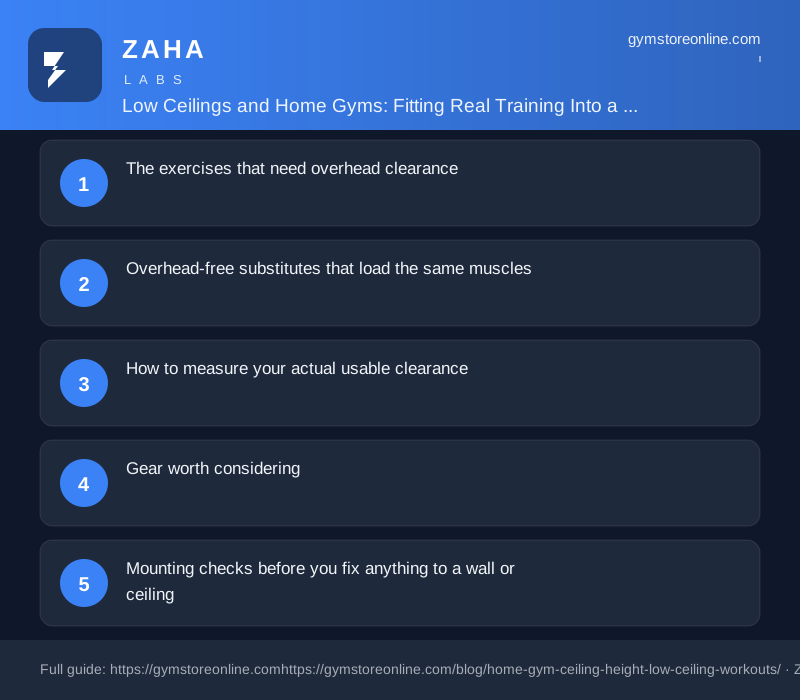
The exercises that need overhead clearance
Four movements stand out as genuinely height-limited:
- Standing overhead press — with arms locked out, a 1.75 m person needs roughly 2.15 m of clearance before the bar. Add a barbell and any margin disappears fast.
- Pull-ups and chin-ups — wall-mounted bars typically sit 20–30 cm below the fixing point. At 2.0–2.1 m room height, trainees much above 1.65 m have no room to hang with straight legs.
- Skipping — a standard rope arc clears roughly 30–35 cm above your head on each rotation, putting the practical minimum at around 2.4 m of clearance.
- Turkish get-ups — the vertical arm extension at the kneeling stage projects a kettlebell 30–40 cm above eye level, depending on arm length and bell size.
Overhead-free substitutes that load the same muscles
Every restricted movement has a workable floor-level alternative:
- Overhead press → seated dumbbell press or landmine press. Seated against a wall, you load the same deltoid and tricep pattern with zero ceiling clearance needed.
- Pull-ups → suspension trainer rows. A door-anchor suspension trainer at mid-chest height gives strong lat and rear-delt work with no vertical clearance requirement at all.
- Skipping → step jacks, lateral shuffles, or outdoor skipping. Moving the rope session outside takes two minutes and removes the problem entirely; a weighted rope gives the same conditioning benefit.
- Turkish get-ups → half-kneeling carries and windmill stretches. Both preserve the shoulder stability intent without the overhead extension phase.
How to measure your actual usable clearance
Don't rely on the room's listed floor-to-ceiling height — that's usually measured at the tallest point. Take a broom handle to your intended training spot, extend it overhead in your normal pressing grip, and ask someone to mark the gap between the handle and the ceiling. That gap is your real working clearance. Bear in mind that loft ceilings frequently slope, so measure at both ends of your training footprint. If the joists are exposed, measure to the lowest point of the timber, not the average span.
Gear worth considering
The following items are well-suited to restricted-height training — none require overhead clearance to use effectively:
- Selector-style adjustable dumbbells — replace an entire fixed-weight rack, store flat under a bench, and cover every exercise in this guide.
- Resistance bands set — anchor low or mid-height for pressing, pulling and mobility work with no overhead component.
- Weighted jump rope — the heavier rope slows rotation and makes a compact arc easier to control when you do have outdoor space.
- All-in-one suspension trainer — door-anchor mount sits well below 2.0 m, covering rows, hinges and split-squat progressions without touching the ceiling.
Browse our full Home Gym Equipment range, or see the home gym essentials checklist for a recommended starter kit.
Mounting checks before you fix anything to a wall or ceiling
- Locate joists or studs first. Plasterboard alone will not hold dynamic loads. Use a stud finder or drive a test screw in a discreet spot before committing to any bracket position.
- Identify your ceiling construction. Timber joists in a loft floor can take pull-up loads if fixed into them correctly. A plasterboard suspended ceiling cannot. If in doubt, ask a builder before drilling.
- Check your lease or rental agreement. Many UK flats prohibit structural fixings without written landlord consent. A freestanding rig or door-anchor suspension trainer sidesteps this entirely.
- Consider impact noise. Dropped weights and plyometric landings travel through floors. Rubber gym matting under your training footprint is a practical step if you have neighbours below.
For more on layout and flooring in smaller spaces, read the small space home gym guide.
Frequently asked questions
What is the minimum ceiling height for a home gym?
There is no universal minimum, but most floor-based and seated strength work is comfortable from around 2.0 m upwards. Below that, stick to floor-level movements and test each exercise with a bar in hand before committing.
Can I fit a pull-up bar in a room with a 2.1 m ceiling?
Possibly, but only for shorter trainees. Most wall-mounted bars sit 20–30 cm below the fixing point, giving around 1.7–1.8 m of usable hang height. Trainees over roughly 1.65 m will need to tuck their knees, or switch to suspension trainer rows anchored lower.
Is skipping possible indoors with a low ceiling?
Rarely. A standard rope arc clears roughly 30–35 cm above the head, putting the practical minimum at around 2.4 m. Moving skipping outside, or replacing it with step-based cardio indoors, is usually the more reliable approach.