Coming Back After a Break: Restarting Home Training Without the Setback
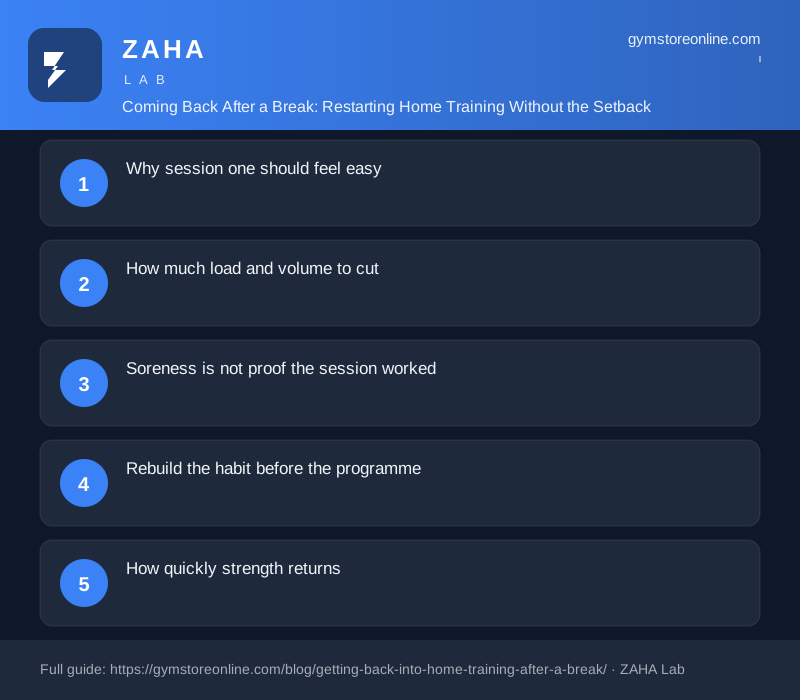
Most people who restart after a layoff go too hard in session one and spend the next three days unable to walk properly. Getting back into home training after a break means cutting your load by roughly half, keeping sessions short, and rebuilding the schedule before you think about intensity.
Why session one should feel easy
After roughly two weeks without training, measurable deconditioning begins. Two weeks is not very long, but it is enough for the body to start adapting to inactivity. After six to eight weeks off, strength drops noticeably and connective tissue adapts more slowly than muscle does once training resumes. Going back at the same load you left is a reliable route to injury, or three days of soreness that kills the new routine before it properly starts.
The goal of session one is to finish feeling like you could have done considerably more. That feeling is the point, not a failure.
How much load and volume to cut
Cut your previous working weight by around 40-50% and halve the number of sets. If you were doing 3 sets of 12 goblet squats at 20 kg before the break, start back at 10 kg for 2 sets of 10. It will feel light. Good. That means the load is calibrated correctly for a first session back.
Volume matters more than intensity at this stage. Build load back up gradually over three to four weeks rather than rushing back to previous numbers. The guide on progressive overload at home explains the week-by-week method in detail.
Soreness is not proof the session worked
Delayed onset muscle soreness (DOMS) after a layoff is almost guaranteed, even from a session that felt laughably easy. It peaks around 24-48 hours after exercise and comes from the body re-adapting to mechanical stress, not from an especially effective session. Chasing DOMS as a measure of a productive workout is a habit worth dropping, particularly after a break.
If you are very sore after session one, reduce the load for session two rather than raising it. Soreness typically settles by the fourth or fifth session. Expect it, but do not use it as a guide for how hard to train.
Rebuild the habit before the programme
Jumping straight into a new 12-week programme is one of the most common home workout mistakes people make on a restart. A fixed 20-minute session at the same time each day, three times a week, works better than an ambitious plan that collapses after ten days.
Pick a time that already fits your day, before work or directly after dinner, and protect it. No skipping, no renegotiating. After two consistent weeks, adding volume or switching to a fuller plan makes sense. The habit comes first.
When to see a GP or physio first: some discomfort during a restart is normal. Chest tightness or unusual shortness of breath during light exercise is not. Neither is sharp joint pain, recent swelling around a joint, or pain from an injury that was not fully cleared before the break. Those warrant a professional assessment before training resumes.
How quickly strength returns
The neuromuscular patterns built through previous training do not disappear cleanly. People who have trained before tend to regain strength significantly faster than those starting from scratch. After a break of four to eight weeks, many people return to their previous working weights within three to four weeks of consistent, progressive sessions, provided technique was already established before the break. This process is sometimes called muscle memory, though the mechanism is primarily neurological.
This is why a restart can feel harder than the numbers suggest. The patterns are still there. The strength follows them.
Gear worth considering
A restart does not need much equipment. Four items cover most sessions in a flat or spare room:
- A resistance bands set for warm-ups, activation work, and lighter resistance while load is being rebuilt.
- Selector-style adjustable dumbbells that let you change weight quickly between sets without swapping plates.
- An extra-thick 10 mm exercise mat for floor work, stretching, and bodyweight exercises.
- A treadmill and equipment floor mat to protect hard floors and reduce noise transmission in flats or terraces.
For a broader overview of what works in a small space, the Home Gym Equipment category covers compact setups in detail.
Frequently asked questions
How long should I rest between sessions when restarting?
Allow at least 48 hours between sessions for the first two weeks. This gives connective tissue time to adapt without accumulating fatigue too quickly. Three sessions a week with rest days between them is a sensible structure at this stage.
Is it normal to lose fitness so quickly during a break?
Some deconditioning after two to three weeks off is normal and expected. Cardiovascular fitness tends to drop faster than strength. Returning to previous levels takes considerably less time than building them in the first place, particularly if the break lasted under two months.
Should I follow a new programme or return to my old one when restarting?
Your old programme is usually the better starting point, since the movement patterns are already familiar. Run it at reduced weight and volume for the first three to four weeks before returning to previous intensity. Starting a completely new programme during a restart adds unnecessary complexity.